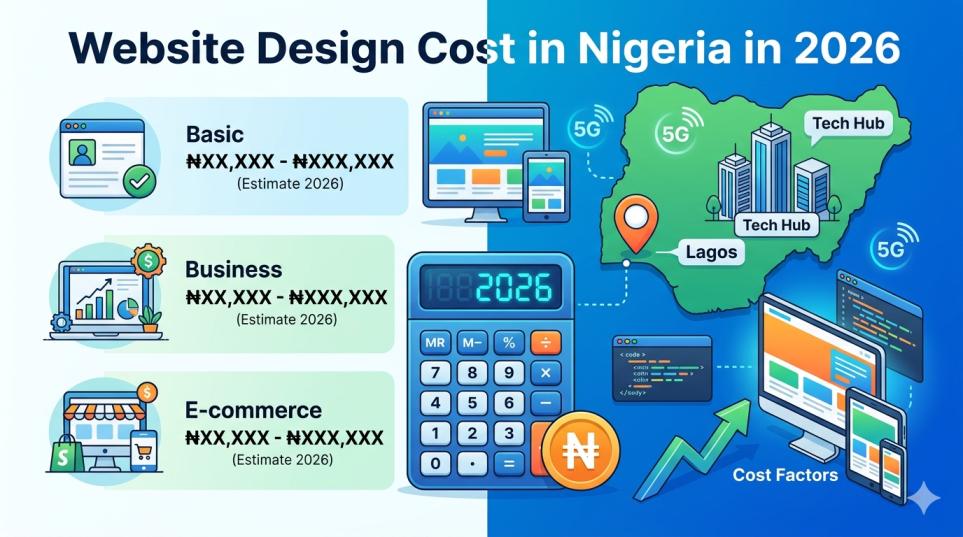
You’ve probably seen the ads: “Get a professional website for ₦50,000!” or maybe you’ve heard horror stories of business owners paying ₦2 million for a site that still doesn’t work properly on a phone. So what’s the truth about website design cost in Nigeria in 2026?
After analyzing pricing data from multiple Nigerian agencies and speaking with business owners who’ve been through the process, one thing becomes clear: the range is massive—from under ₦100,000 to well over ₦5 million. But here’s what nobody tells you: the cheapest option often costs the most in the long run, and the most expensive isn’t always the best fit for your business.
Let’s cut through the confusion and give you real numbers, what you’re actually paying for, and how to avoid the mistakes that leave Nigerian business owners with useless websites .
Before we dive into numbers, understand this: there’s no universal price tag. Web design costs vary based on several factors, and knowing them helps you ask the right questions when getting quotes .
A simple five-page brochure site costs significantly less than an e-commerce store with payment integration. Here’s the spectrum:
| Website Type | Estimated Cost Range (₦) | Key Features |
|---|---|---|
| Basic Informational Site (5-10 pages) | 150,000 – 400,000 | Mobile-friendly, contact forms, basic SEO, CMS |
| Corporate/Business Site (10-20 pages) | 250,000 – 650,000 | Custom design, blog, advanced functionality |
| E-commerce Store | 350,000 – 1,500,000+ | Payment gateway (Paystack/Flutterwave), product catalog, inventory management |
| Custom Web Application | 1,000,000 – 5,000,000+ | Tailored solutions, complex integrations, custom code |
Sources:
The website design cost in Nigeria changes dramatically based on who you hire:
Freelancers: ₦100,000 – ₦400,000. More affordable, but quality varies, and availability can be inconsistent .
Small Local Agencies: ₦300,000 – ₦800,000. Sweet spot for most SMEs—professional support without enterprise pricing .
Large/International Agencies: ₦1,000,000+. Full-service teams, but often overkill for small businesses .
Your technology choice affects both upfront and ongoing costs:
WordPress: Most cost-effective for 80% of Nigerian businesses. Lower development costs, easy to update yourself .
Custom Code (PHP, React, etc.): ₦800,000+ for development. Necessary only for unique functionality WordPress can’t handle .
Shopify/Wix/Hostinger: ₦2,000 – ₦30,000/month subscription models—great for DIY with local payment support .

Perfect for startups, professionals, and local service businesses. These sites typically include:
5–10 pages (Home, About, Services, Contact, Blog)
Mobile-responsive design
Basic SEO setup
Contact forms and social media integration
*Example: A lawyer in Lagos built a 7-page site for ₦300,000 that included client testimonials and a blog section. It generated 12 client inquiries in the first month .*
For businesses ready to compete seriously online. You get:
10–20 pages with custom design
Lead generation features (contact forms, booking systems)
Enhanced SEO structure
Content management system for easy updates
This range typically delivers the best value for established Nigerian SMEs .
Online stores require more investment because they handle money. Your cost depends on:
Number of products (50–100 products: ₦450,000–₦700,000)
Payment gateway integration (Paystack/Flutterwave add ₦50,000–₦100,000)
Inventory management complexity
Shipping and order tracking features
*Example: A fashion retailer with 200+ products and multiple payment gateways spent ₦700,000 on their e-commerce site in 2025 .*
These are full software platforms built for specific business needs:
School management systems with student portals
Booking and reservation platforms
Multi-vendor marketplaces
Fintech dashboards and reporting tools
These projects typically take months, not weeks, and require ongoing maintenance .
Smart business owners budget beyond the initial build. Here’s what keeps your site running:
| Expense | Annual Cost (₦) | Notes |
|---|---|---|
| Domain Renewal | 8,000 – 50,000 | .com or .ng domains; first year often free |
| Web Hosting | 25,000 – 150,000+ | Shared hosting for smaller sites; VPS for e-commerce |
| SSL Certificate | 5,000 – 20,000 | Often included with quality hosting |
| Maintenance & Support | 120,000 – 600,000 | Monthly retainers (₦10,000–₦50,000/month) |
| Premium Plugins/Themes | 15,000 – 50,000 | Annual licenses for essential tools |
Sources:
Critical warning: Websites that skip maintenance become security risks. One client saved ₦30,000 on cheap hosting—then lost three months of sales when their site kept crashing. Quality infrastructure matters .
If you’re budgeting around the average website design cost in Nigeria, here’s what a professional package includes:
✅ Custom WordPress design (not a generic template)
✅ 5–10 pages with strategic content structure
✅ Mobile optimization (critical—75%+ of Nigerian users browse on phones)
✅ Basic on-page SEO (titles, meta descriptions, site structure)
✅ Contact forms and lead capture
✅ 2–4 weeks development time
✅ Training on how to update your site
What it typically doesn’t include:
❌ Advanced SEO campaigns (₦100,000–₦700,000 monthly extra)
❌ Professional copywriting (₦50,000–₦150,000 extra)
❌ Ongoing content creation and marketing

Choose a freelancer if:
You’re on a tight budget (under ₦300,000)
Your needs are straightforward (5–10 pages, basic features)
You have time to vet their portfolio carefully
You’re comfortable handling your own ongoing maintenance
Choose an agency if:
Your website is a revenue-generating asset
You need ongoing support and marketing integration
You want accountability and backup resources
You’re building e-commerce or complex functionality
The continuity argument matters: when a site breaks six months after launch, an agency has a team to call. A freelancer may or may not be reachable .
Protect your investment by avoiding these common pitfalls:
“Too good to be true” prices – A ₦50,000 website likely means no SEO, poor hosting, or stolen templates .
No portfolio with real results – Professional designers should show case studies with measurable outcomes, not just screenshots .
Unclear ownership – Ensure you own your domain and hosting credentials. Some agencies retain access as leverage .
No maintenance plan – Ask: “What happens if something breaks six months from now?” .
Skipped strategy phase – Low-budget projects often jump straight to design without understanding your business goals. This produces a website that doesn’t perform .
Instead of waiting to afford everything at once, launch with core pages (Home, Services, Contact) and add features as your business grows .
With over 75% of Nigerian web traffic on mobile devices, a site that doesn’t work well on smartphones won’t work at all .
Building SEO into your site structure costs little upfront. Adding it later costs more and delivers slower results .
Can you show me case studies with performance data?
Who owns the domain and hosting credentials at handover?
Can I update the site myself after launch?
What does post-launch support cost, and what does it cover?
| Business Type | Recommended Budget | What to Expect |
|---|---|---|
| Startup/Lean | ₦150,000 – ₦250,000 | Template-based, minimal features, gets you online |
| Established SME | ₦250,000 – ₦600,000 | Custom design, lead generation focus, SEO-ready |
| E-commerce Store | ₦450,000 – ₦1,000,000+ | Payment integration, product management, scalability |
| Enterprise/Complex | ₦1,000,000 – ₦5,000,000+ | Custom functionality, integrations, premium support |
Source:
The true website design cost in Nigeria isn’t what you pay upfront—it’s what you lose with a site that doesn’t perform. A ₦200,000 website that generates zero leads is more expensive than a ₦500,000 site that brings in customers every month .
Your website is your digital storefront, sales representative, and credibility engine combined . Choose a partner who understands your business goals, not just one who promises the lowest price.
Start with clarity—define your goals, set a realistic budget, and ask the right questions before signing anything.
Need help finding a reliable web design partner? Explore our recommended web design packages or contact our team [at Weblyn Agency]for a free consultation to discuss your specific needs.
Have you built a website recently in Nigeria? What was your experience with pricing and quality? Share your thoughts in the comments below—your insights could help another business owner make a better decision.